
Architecting Intelligent Systems
AI Product Development Lifecycle

The advent of readily accessible AI tools has democratized the field, leading to a surge in AI-powered applications. However, building a successful AI product requires more than just plugging in a pre-trained model. It demands a robust and well-defined development lifecycle that acknowledges the unique challenges and intricacies of AI. This article provides a comprehensive and technical exploration of the AI product development lifecycle.
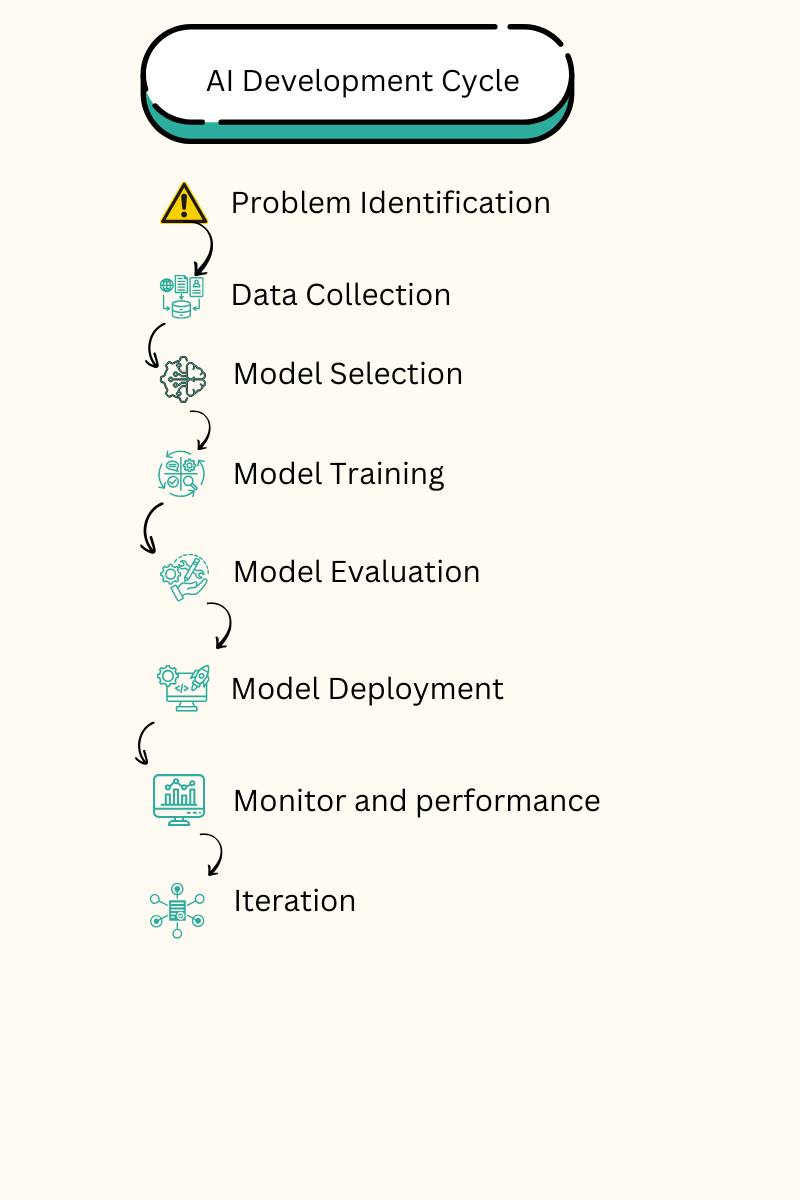
Phase 1: Ideation and Conceptualization - Beyond the Hype
While the allure of AI is strong, it is crucial to ground your project in a genuine need. This phase transcends mere brainstorming, it involves:
Problem validation: Rigorously analyze the problem. Is ML/AI truly the optimal solution? What are the quantifiable benefits of using AI?
Defining Scope and Objectives: Clearly articulate the project’s goals, functionalities, and constraints. Establish measurable success metrics.
Feasibility Analysis: Evaluate the technical feasibility. Do suitable datasets exist? Are there computational resource limitations?
Phase 2: Data Acquisition and Preparation- The Foundation of AI
Data is the lifeblood of any AI system. This phase is arguably the most critical and often the most time-consuming.
Data Sourcing. Identify and acquire relevant data sources. This may involve public datasets, web scraping, data augmentation, or collaborations.
Data Cleaning and Preprocessing: Handle missing values, outliers, and inconsistencies. Transform data into a suitable format for model training.
Data Labelling: For supervised learning, accurately label the data, potentially employing techniques like active learning or crowdsourcing.
Data Splitting: Divide data into training, validation, and test sets to ensure robust model evaluation and generalization.
Phase 3: Model Development and Training - The Art and Science of AI
This phase involves selecting, building, and optimizing the AI model.
Algorithm Selection: Choose an appropriate algorithm based on the problem type(classification, regression, clustering, etc), data characteristics, and desired performance.
Model Architecture: Design the model architecture, including the number of layers, neurons, and activation functions. Consider transfer learning to leverage pre-trained models.
Hyperparameter Tuning: Optimize model parameters (learning rate, batch size, regularization) using techniques like grid search, random search or Bayesian optimization.
Training Process: Train the model on the prepared dataset, monitoring performance metrics and adjusting parameters.
Phase 4: Model Evaluation and Validation - Ensuring Robustness and Reliability
A thorough evaluation is crucial to ensure the model meets all the defined objectives and generalizes well to unseen data.
Performance Metrics: Based on the problem type, select appropriate metrics, such as accuracy, precision, recall, F1-score, AUC-ROC, or mean squared error.
Validation Techniques: Employ techniques like cross-validation, hold-out validation, or bootstrapping to assess model robustness.
Bias and Fairness Evaluation: Analyze the model for potential biases and fairness issues, using techniques like disparate impact analysis or equal opportunity difference.
Phase 5: Deployment and Integration- Bringing AI to Life
This phase involves integrating the trained model into a production environment and making it accessible to users.
Deployment Strategies: Choose a suitable deployment strategy based on the application requirements, such as cloud deployment, on-premise deployment, or edge deployment.
API Development: Develop APIs to allow seamless interaction with the AI model.
Monitoring and Logging: Implement monitoring tools to track the model performance, usage patterns, and potential errors.
User Interface(UI) Design: if applicable, design a user-friendly interface for interacting with the AI model.
Phase 6: Monitoring and Maintenance - The Continuous Evolution
Deploying an AI model is not the end of the journey. Continuous monitoring and maintenance are critical to ensure long-term performance and value.
Performance Tracking: Continuously monitor key performance indicators and identify potential performance degradation.
Model Retraining: Retrain the model periodically with new data to maintain accuracy and adapt to evolving patterns.
Version Control: Maintain version control for models and datasets to track changes and facilitate rollbacks if needed.
Feedback Loop: Establish a feedback mechanism to gather user feedback and identify areas of improvement.
By embracing the ideal AI product development lifecycle, we can build resilient intelligent systems that deliver lasting value.